

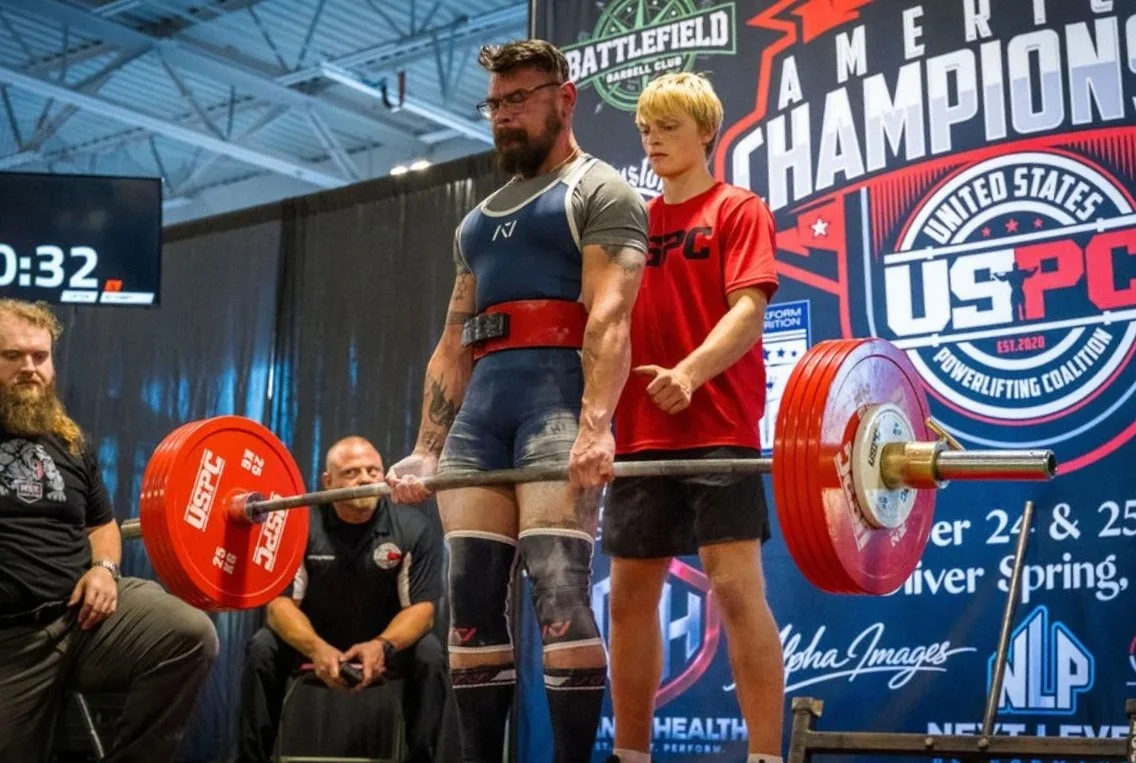
USPC America’s Championship 2026 | October 24th: John Rhoads 535.7 pounds deadlift and IPC World Record setting lift.
Sometimes the greatest accomplishments begin with a question we can't find a good reason to say no to.
At the beginning of 2026, I was helping organize a Barbell Club Challenge at my local gym. During a conversation, a friend noticed how much stronger I had become and casually mentioned something that would change the direction of my entire year.
"A few of us are going to compete in a powerlifting meet in April. Why don't you join us?"
At the time, I was 37 years old. Although I had been strength training for years, most of my personal fitness goals had revolved around aesthetics. I was far more concerned with how much muscle I could build and how I looked than how much weight I could actually move.
Powerlifting wasn't something I had seriously considered.
But his question stuck with me.
Why not?
I couldn't come up with a particularly good reason not to try. So, I agreed.
What I didn't realize at the time was that this seemingly insignificant conversation would teach me more about myself than I anticipated.
Leading by Example
The more I thought about competing, the more I realized that this opportunity extended beyond my own fitness goals.
I began thinking about my oldest stepson.
Neither of us is particularly comfortable putting ourselves in situations where others can judge our performance. There's something inherently uncomfortable about stepping in front of an audience, knowing that people are watching, and accepting that you might fail.
As a parent, I can tell my children all day long that they should be confident, take chances, and not worry about what other people think. But what good is that advice if I'm unwilling to follow it myself?
This was an opportunity to put my money where my mouth was.
I wanted to show him that being uncomfortable isn't necessarily a reason to avoid something. That trying something new can be intimidating regardless of your age or experience.
More importantly, I wanted him to understand that you don't have to be certain you'll succeed before you're willing to try.
So, at 37 years old, I decided to put myself out there.
Not because I thought I was going to win, but because I wanted to prove to myself, and hopefully demonstrate to my children, that there's value in simply having the courage to participate.
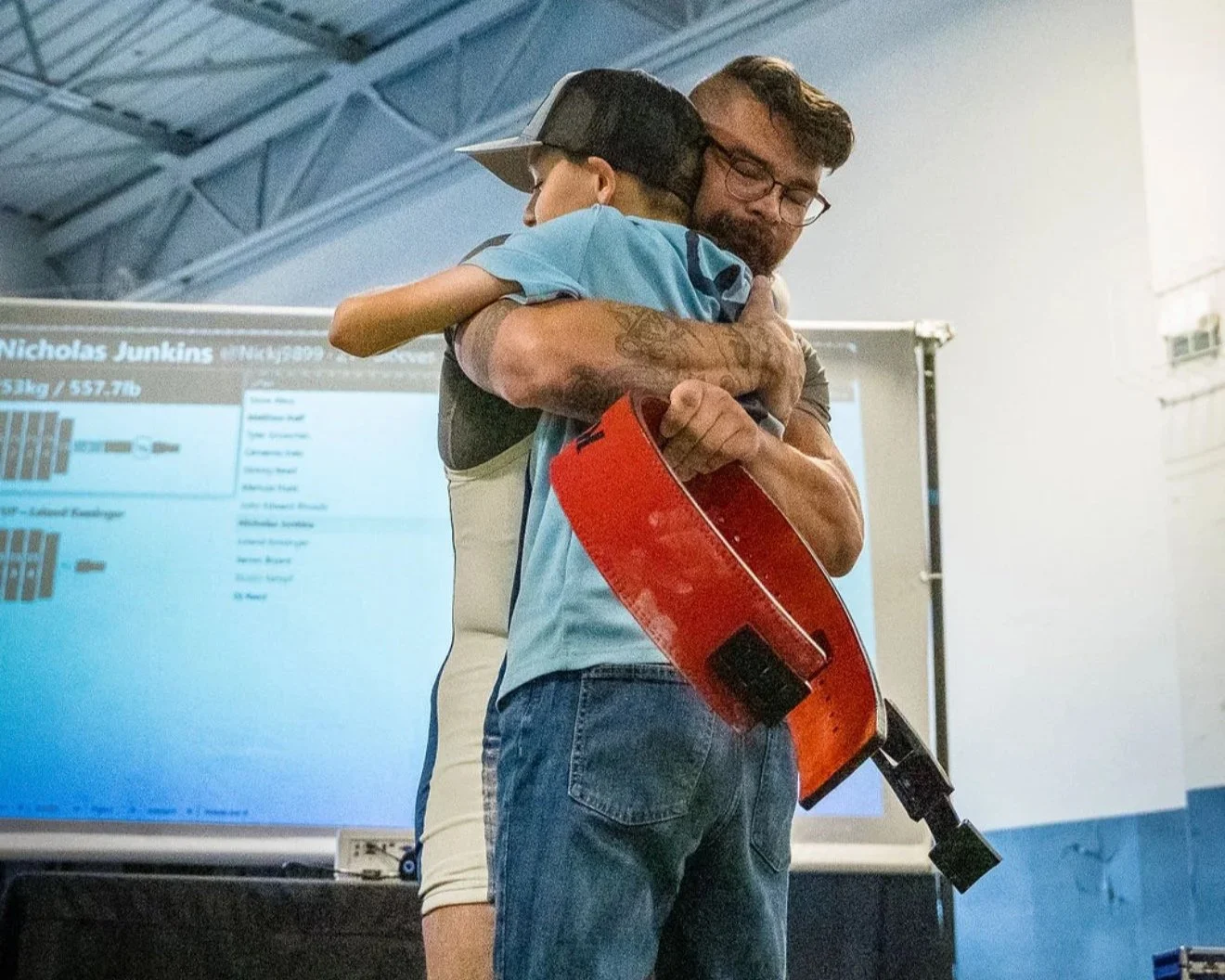
USPC America’s Championship 2026 | October 24th - Final lift celebration.
From the Gym to the Platform
After deciding to compete, I approached a friend who would eventually become my strength coach, a role he continues to fill today.
Together, we developed a training plan for the United States Powerlifting Coalition (USPC) Bar Fight on April 25, 2026, in Parkersburg, West Virginia.
For the next several months, my training became increasingly focused on the three primary powerlifting movements: squat, bench press, and deadlift.
I followed the program, trusted the process, and watched my strength increase beyond anything I had previously accomplished.
Before the official competition, I participated in our local gym's Barbell Club Challenge, which I had helped organize. Although I wasn't pushing myself to my absolute limits, I managed to total more than 1,250 pounds across the three lifts.
It was an encouraging experience, but the real test was still ahead.
Then competition day arrived.
My first sanctioned meet. My first experience competing under the rules and expectations of an established federation.
And, to my surprise, I took first place in my division, totaling approximately 1,294 pounds.
Was I excited? Absolutely.
Winning wasn't why I had entered, but I'd be lying if I said it didn't feel good.
I had stepped outside my comfort zone, committed to something unfamiliar, and accomplished more than I originally set out to do.
As far as I was concerned, that was a pretty successful experience.
But apparently, the story wasn't finished.
"Because You Qualified."
Not long after the competition, another lifter from my gym sent me a message.
He asked if I was planning to compete at nationals.
My response was immediate.
"Why would I do that?"
His answer?
"Because you qualified."
Wait. What?
I genuinely had no idea what he was talking about.
I went online and started researching the qualification requirements. As it turned out, the competition I had just participated in was a regional qualifier for the USPC America's Championship.
The qualifying criteria included earning a medal at a regional qualifying meet or achieving a DOTS score of at least 400.
For those unfamiliar, DOTS is a scoring system used in powerlifting that accounts for an athlete's bodyweight, allowing performances to be compared across different weight classes.
I had accomplished both.
With a first-place finish and a DOTS score of just over 405, I had earned the opportunity to compete at the USPC America's Championship in Oliver Springs, Tennessee.
Once again, I found myself facing a familiar question.
Why not?
The Reality of Pushing Further
I approached my coach about competing again.
He was supportive, but he also cautioned me about the physical demands of preparing for two major competitions in the same year. Training intensity, accumulated fatigue, and recovery would all need to be carefully managed.
Nevertheless, he agreed to help me prepare.
We structured the next six months around approximately three months of offseason training followed by another three months of competition preparation.
And this time, things weren't nearly as smooth.
Although my strength continued to develop, I began experiencing issues with movement patterns, particularly around my shoulder blade, neck, and biceps.
Squatting and especially bench pressing became increasingly uncomfortable. At times, the discomfort bordered on pain.
As a personal trainer and corrective exercise specialist, I understand the importance of movement quality, recovery, and appropriate training modifications.
But understanding those principles and applying them to yourself when you're pursuing a personal goal can be two very different things.
There were frustrating training sessions. There were days when movements that had previously felt natural suddenly became uncomfortable. There were times when my progress wasn't reflected by the weight on the bar.
Fortunately, as competition approached, the symptoms began to settle. During the final two weeks, the pain diminished to discomfort, and eventually became barely noticeable.
It wasn't the preparation I had envisioned, but I had done what I could with the circumstances in front of me.
And sometimes, that's all you can ask of yourself.
Six Months Later: America's Championship
On October 24, 2026, almost exactly six months after my first sanctioned competition, I stepped onto the platform at the USPC America's Championship.
I wasn't feeling my best physically. I had been under the weather, and the training setbacks had certainly affected my preparation.
Nevertheless, I competed.
Compared with April, my squat improved by approximately 20 pounds, my bench press decreased by about 7 pounds, and my deadlift improved by nearly 7 pounds.
It wasn't a personal record on every lift. I failed to complete my third squat and bench attempts, but it was progress.
More importantly, it was progress achieved during a training cycle that had presented challenges I hadn't anticipated.
By the end of the competition, I had earned first place in three divisions: Men's 82.5 kg Open, Submasters, and Frontline.
I also earned seven International Powerlifting Coalition (IPC) world-record listings across the federation's All Events and Full Power categories.
Even now, writing that feels a little surreal.
Less than a year earlier, I had never competed in powerlifting. Now, I was returning home from a major competition with three first-place medals and seven world records recognized by the IPC.
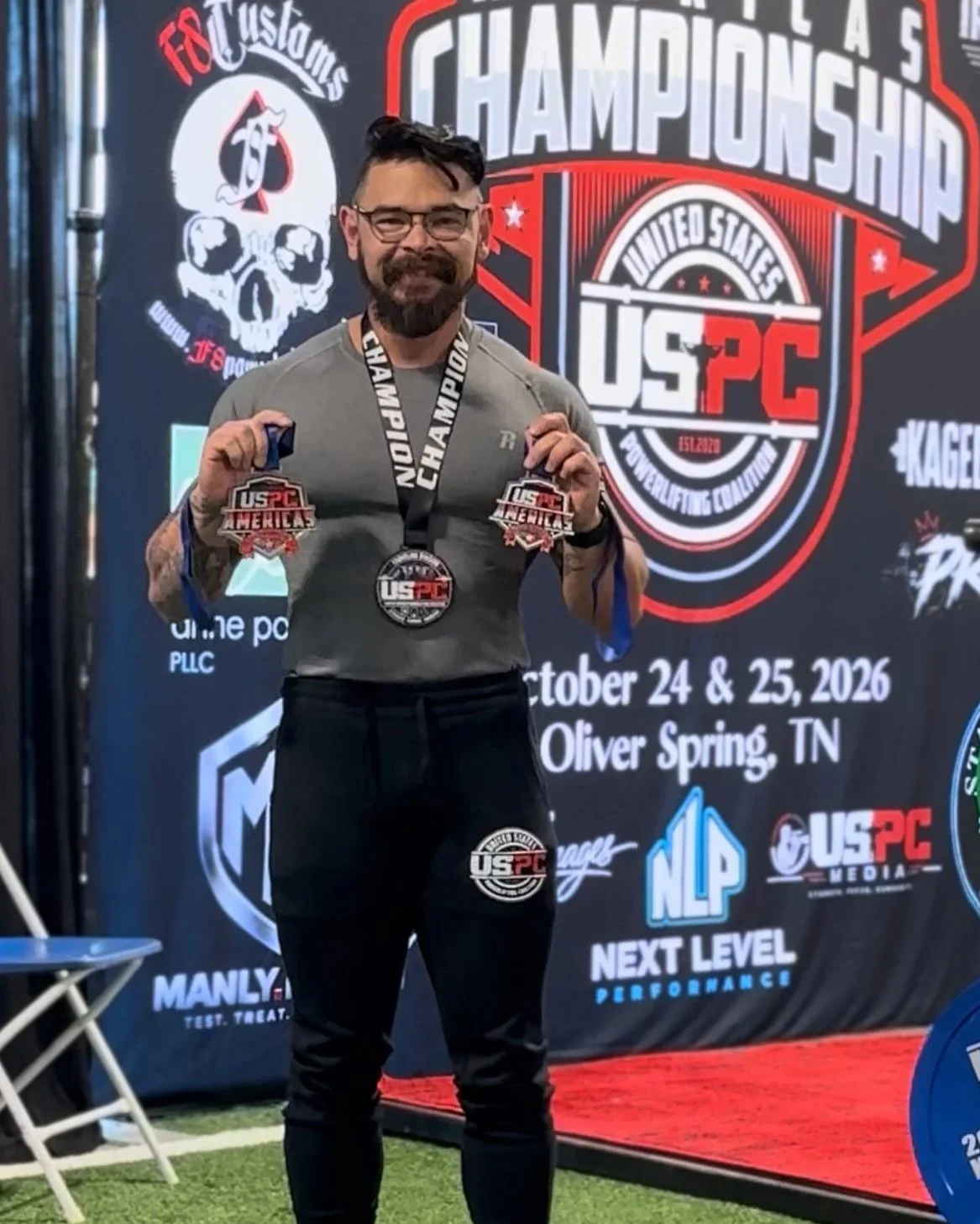
USPC America’s Championship 2026 | October 24th - Awards with first place medals in the Men’s 82.5 KG Open, Submasters, and Frontline Divisions.
But here's something I think is far more important than any of those accomplishments.
If I could go back and compete all over again, knowing I would come home without a single medal or record, I would still do it.
YES!!!
Why?
Because of the people.
Throughout both competitions, I had the opportunity to meet some incredibly inspiring, hardworking, and supportive individuals.
Athletes who understood the discipline required to prepare for competition. People who genuinely celebrated each other's accomplishments, even when competing against one another.
There was encouragement from people I had never met, conversations with athletes from different backgrounds, and a shared appreciation for the work that brought all of us to the same platform.
That community is something I hadn't anticipated finding when I first agreed to compete.
And it's something I wouldn't trade for another medal.
Strength Is More Than a Number
As a coach, I've spent years helping people improve their physical health, strength, and confidence.
I've also spent considerable time teaching the importance of consistency and setting realistic, achievable goals.
Interestingly, the American College of Sports Medicine reinforced these principles in its updated 2026 resistance training guidelines.
Drawing from 137 systematic reviews representing more than 30,000 participants, the ACSM emphasized that consistent, individualized resistance training is more important for most adults than chasing an unnecessarily complicated or supposedly perfect training program.
Of course, competitive powerlifting requires more specialized preparation, but the underlying principle remains relevant.
Consistency matters.
Showing up matters.
And sometimes, the willingness to begin is more important than having every detail figured out.
Source: American College of Sports Medicine — 2026 Resistance Training Guidelines.
Looking back, I realize that the most meaningful part of this experience had very little to do with how much weight I lifted.
It was about challenging the limits I had unconsciously placed on myself.
It was about accepting that I might fail in front of other people and deciding that the possibility of failure wasn't enough to stop me.
And it was about showing my children that personal growth doesn't have an age limit.
At 37, I decided to try something new.
At 38, I accomplished things I hadn't even considered possible the year before.
But I don't want the lesson my children take from this experience to be that their step dad won medals or set records.
I want them to understand that their step dad was willing to try something uncomfortable, work hard for it, and accept whatever outcome came with that decision.
Because the willingness to try is something worth being proud of, regardless of where you finish.
What's Next?
For now, it's time for an offseason.
I'm planning to spend the next three to four months addressing some of the physical issues that developed during my competition preparation.
That means having my shoulder evaluated, potentially pursuing physical therapy or osteopathic treatment, and shifting my training toward a broader emphasis on mobility, muscular endurance, explosive strength, and improving the stability and resilience of my shoulders and core.
I want to return to training with better movement quality, fewer limitations, and a stronger foundation for whatever comes next.
Which brings me to the next question.
Do I compete internationally in May 2027?
I'm leaning toward yes.
But there are a few things I need to address before making that decision, and time will ultimately determine whether it's the right opportunity.
For now, I'm grateful for the experience, my coach, the athletes I've met, and the family and friends who have supported me throughout the process.
And when I think about everything that's happened this year, I keep coming back to the same two words that started it all.
Why not?
Maybe that's a question we should all be willing to ask ourselves a little more often.
